Ti-6Al-4V Prosthetic Hip Implant — Structural Simulation, Failure Analysis & Mass Optimisation
A finite-element study spanning hand-derived stiffness formulation, MATLAB PDE solvers, and CAD-based simulation — validating each result across analytical, numerical, and commercial-solver methods. Work covers 2D truss FEM from first principles, Kirsch hole stress-concentration verification, and a full design–analyse–optimise loop on a prosthetic hip implant, emphasising mesh convergence and physically-grounded boundary conditions over black-box solver output.
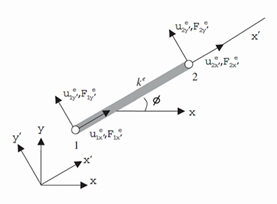
- Derived element stiffness matrices from force equilibrium and assembled global FEM systems via coordinate-transform rotation and like-DOF superposition.
- Partitioned systems into essential/free DOFs to solve for unknown displacements and reaction forces under mixed boundary conditions.
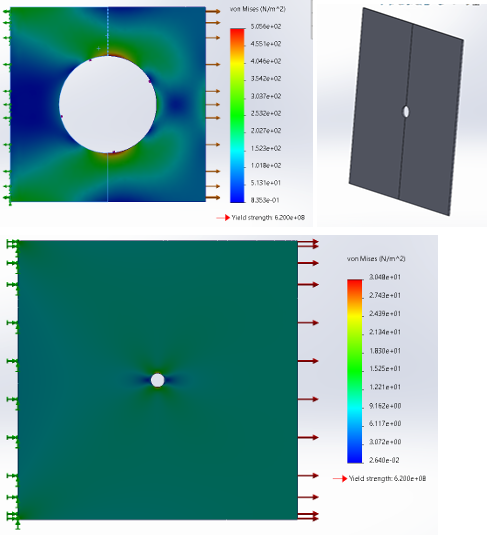
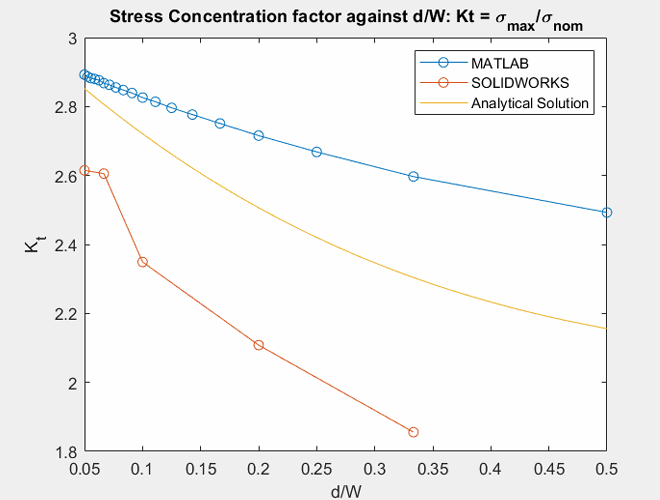
- Cross-validated results three ways — analytical (Kirsch), custom MATLAB solver, and SOLIDWORKS — quantifying divergence and its physical/numerical causes.
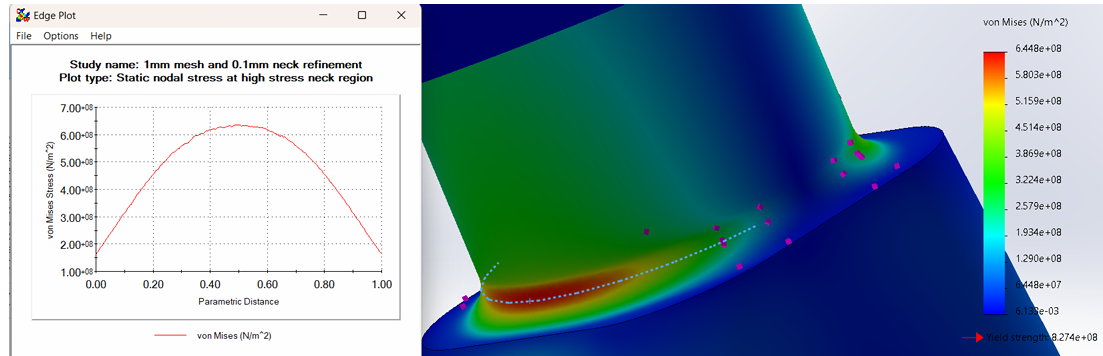
- Mesh refinement and convergence studies with localised control, exposing a ~50% peak-stress underestimate that coarse meshing missed.
- Boundary-condition design balancing stability, realism, load flow, and avoidance of artificial over-constraint.
- Design iteration against quantitative failure criteria — von Mises vs. yield, safety factor, mass reduction.
Discretised a pin-jointed truss into 2D rod elements, deriving the element stiffness matrix under axial equilibrium and transforming local-to-global via rotation matrices. Assembled the global stiffness system, partitioned into essential/free DOFs, and solved for nodal displacements, reaction forces, and per-member axial stress — implemented as a parameterised MATLAB script.
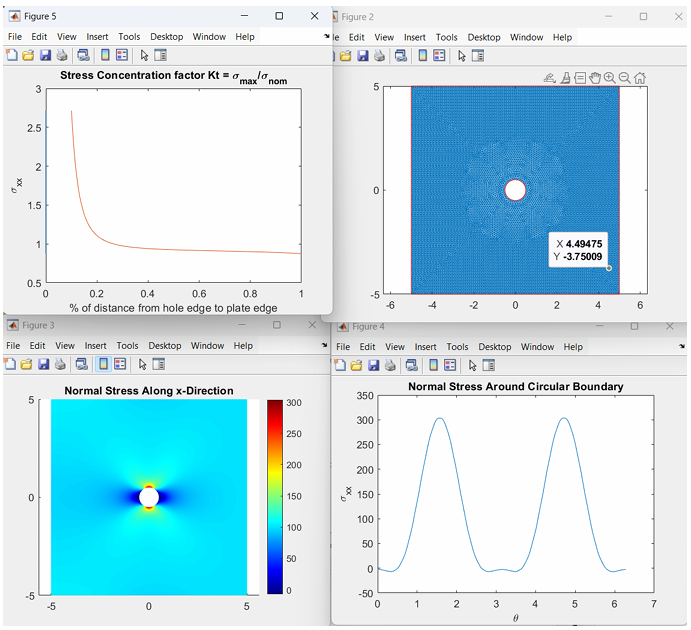
Modelled a uniaxially-loaded thin plate with a central hole in MATLAB’s PDE framework, sweeping the d/w ratio to recover the classical factor-of-three stress concentration as the geometry approaches an infinite plate. Benchmarked against both Kirsch’s analytical solution and a 3D SOLIDWORKS model, characterising mesh- and dimensionality-driven divergence.
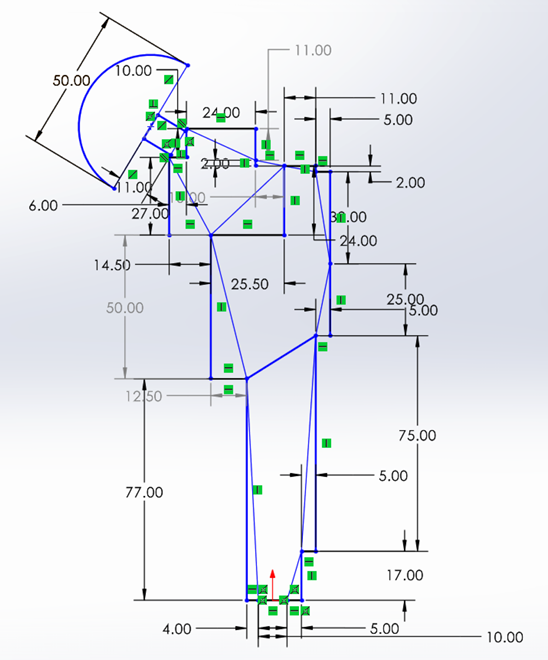
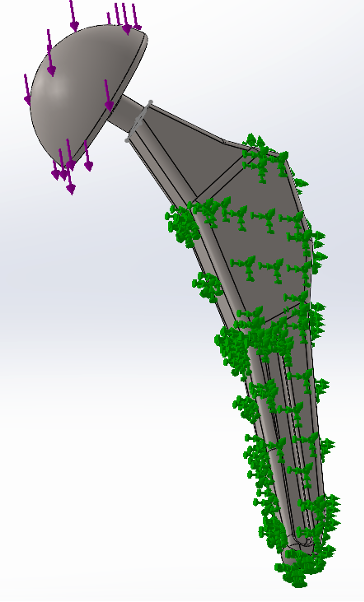
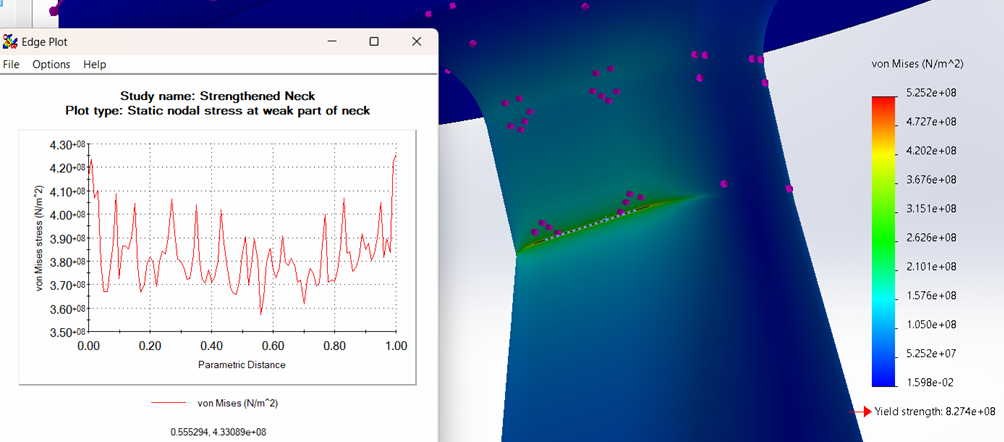
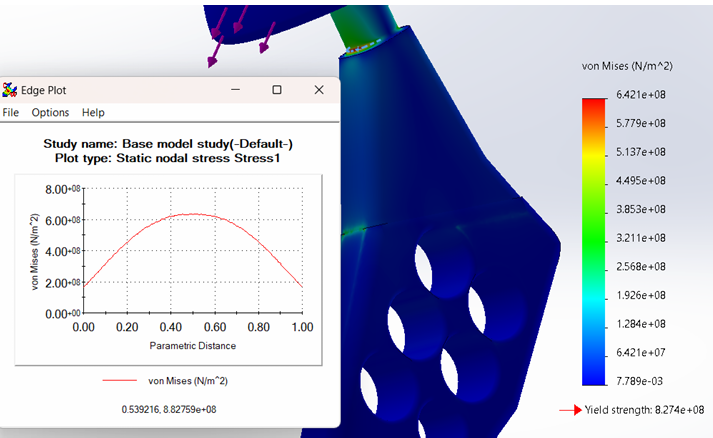
Full CAD-to-FEA workflow on a Ti-6Al-4V hip implant: parametric SOLIDWORKS model, physically-reasoned fixturing (fixing only high-contact faces to avoid artificial stiffness), and static loading emulating body weight. Identified a mesh-sensitive neck stress concentration and bending failure mode, then resolved it through geometry strengthening (flush stem, enlarged fillet) to reach a safety factor of 2, and ran a hole-diameter design study trading mass against structural integrity.