Systems Modelling & Optimisation
Stochastic Microgrid Energy Management — State-Space Battery Modelling, Simulink Co-Simulation & Techno-Economic Optimisation
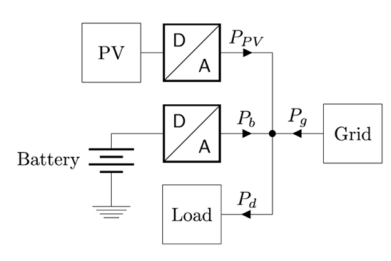
A closed-loop PV–battery–grid–load microgrid modelled end to end, from first-principles battery circuit dynamics through to dollar-denominated system economics: a hand-derived state-space battery model, driven by stochastic generation and demand profiles, dispatched by a rule-based controller, and evaluated for cost, payback, and sizing under both grid-tied and fully-islanded configurations — benchmarked throughout against real market pricing rather than simplified cost assumptions.
MATLAB/Simulink (State-Space & Bode Plot blocks, MATLAB Function blocks, model callbacks/InitFcn) · stochastic signal modelling · rule-based finite-state energy dispatch · techno-economic and sensitivity/design-space analysis · market-data literature benchmarking
State-Space Modelling & Frequency-Domain Analysis
- Derived a fourth-order state-space model of the battery subsystem by hand from its equivalent circuit and cascaded sensor-filter dynamics, capturing both the true and measured versions of each internal state.
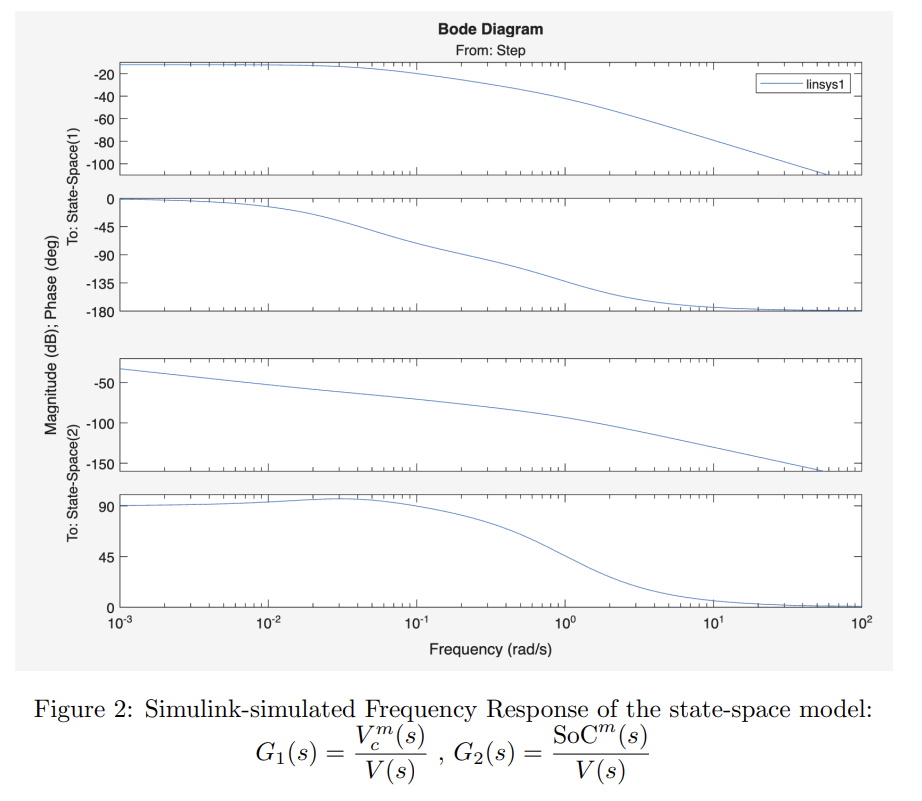
- Extracted and interpreted the system’s frequency response, correctly distinguishing the battery’s fast electrical dynamics (a textbook low-pass response) from its slow energy-accounting dynamics (a pure-integrator signature), explaining each from underlying circuit and battery-physics reasoning.
- Characterised the time-domain step response with closed-form checks against the circuit’s steady-state gain and dominant time constant, and correctly recognised that conventional step-response metrics don’t apply to the integrator-governed state, substituting an appropriate alternative characterisation instead.
Simulink Architecture, Stochastic Simulation & Rule-Based Dispatch
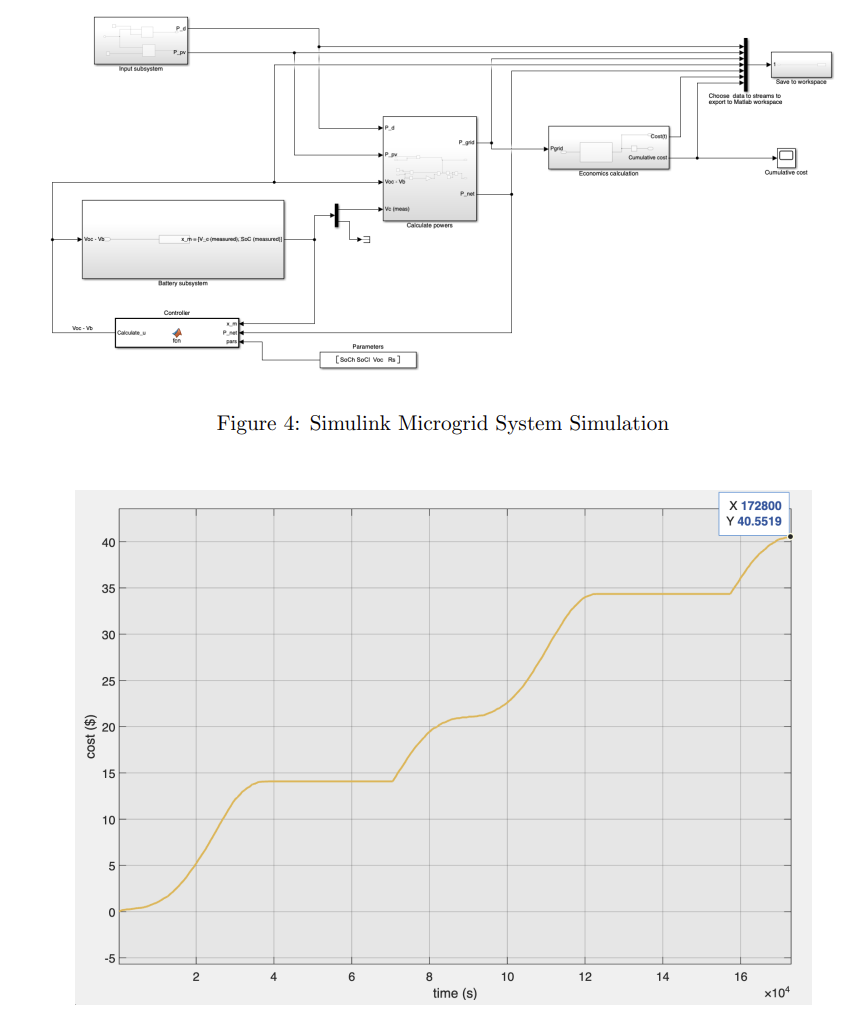
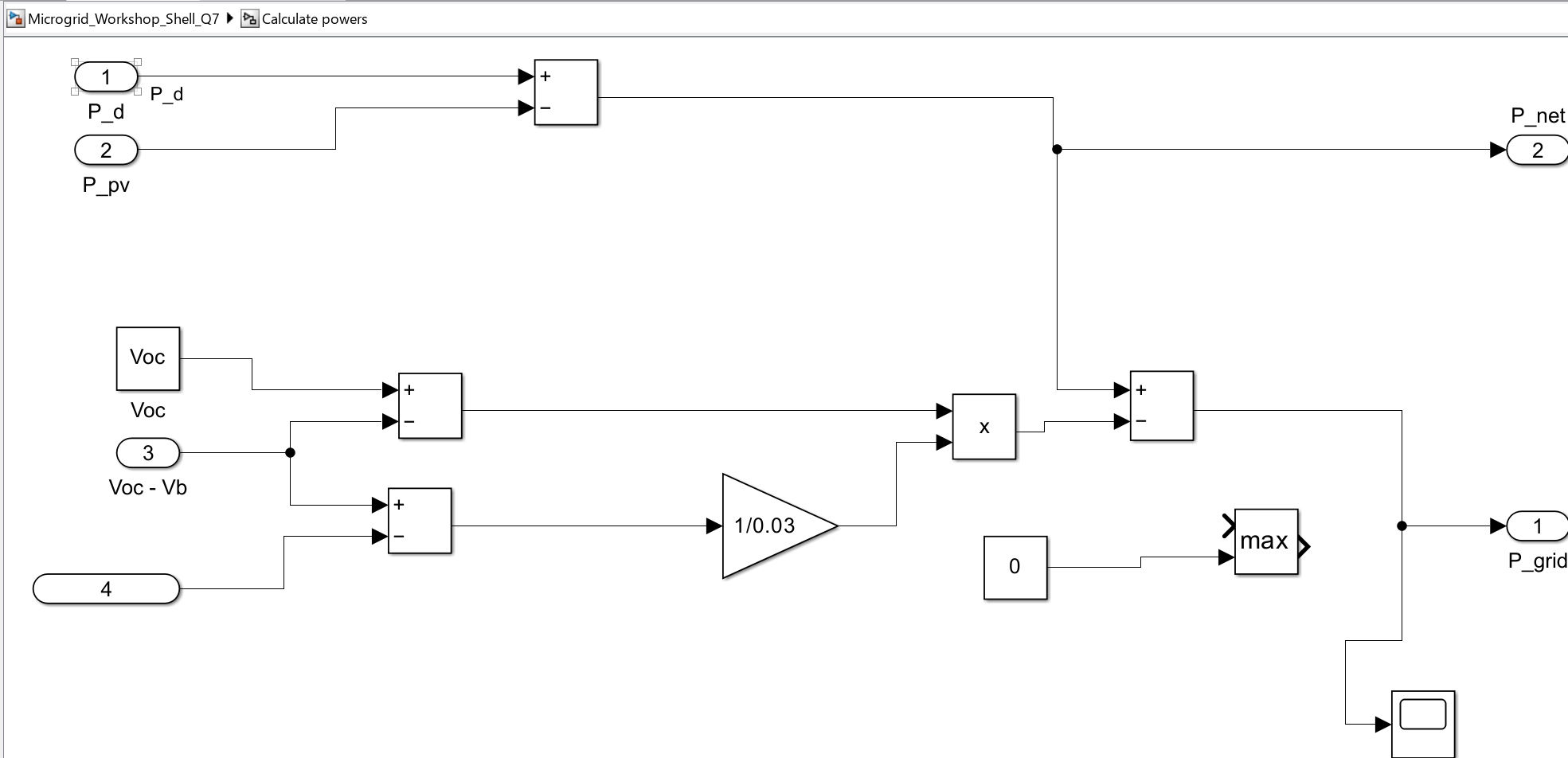
- Built the full closed-loop microgrid block diagram around a provided controller shell, wiring measured internal states into a function-block controller for hardware-representative closed-loop operation.
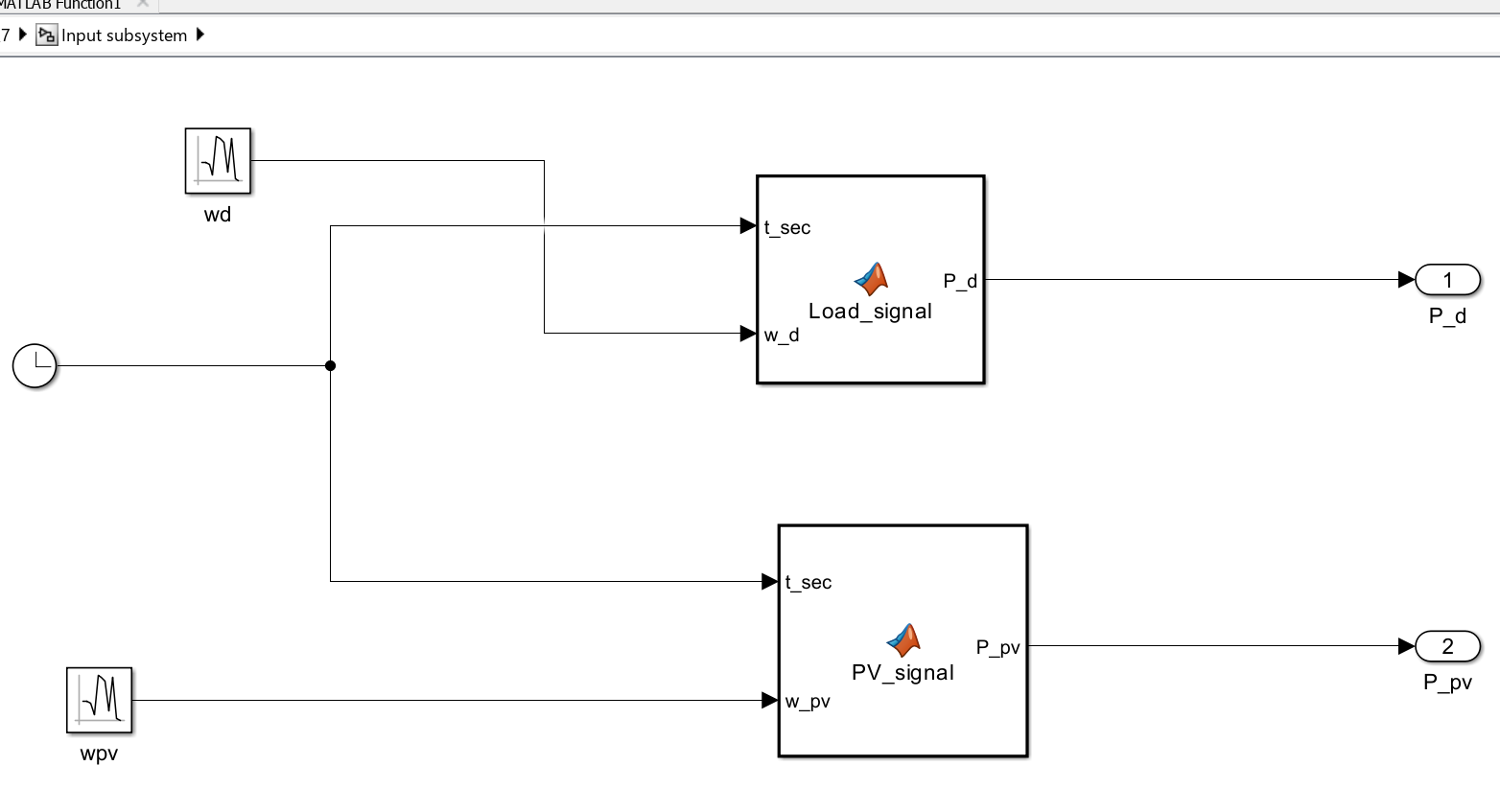
- Modelled solar generation and residential load as realistic daily profiles corrupted by independent random disturbances, and modelled grid cost settlement as a filtered, integrated economic signal — with careful attention to unit consistency across the mixed electrical, energy, and financial timescales involved.
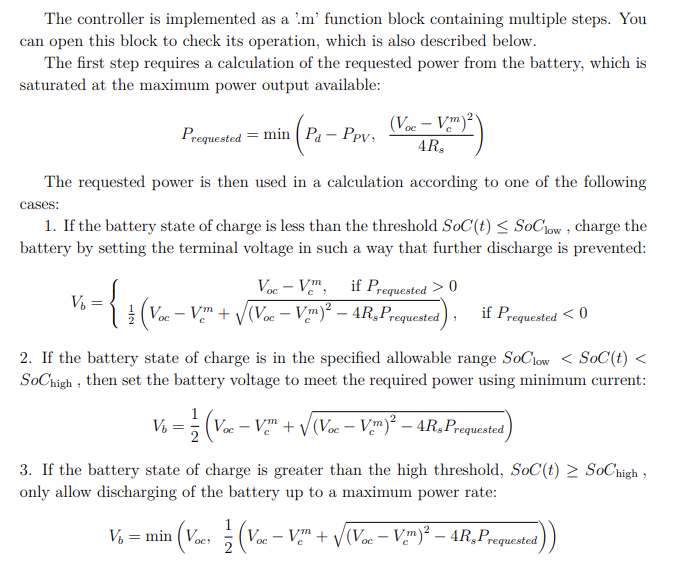
- Implemented a threshold-switching, rule-based charge/discharge controller that bounds requested battery power against its physical maximum-power-transfer limit, correctly handling distinct charge-priority, minimum-current, and discharge-limited operating regimes.
- Diagnosed a transient effect of initial battery state on operating cost, correctly attributing it to controller-threshold-crossing timing rather than any steady-state difference, and extended the system to support bidirectional grid export under an asymmetric feed-in tariff.
Techno-Economic Optimisation & Sustainability Analysis
- Quantified the battery’s return on investment against a grid-only baseline, establishing a payback period of a few months under the workshop’s cost assumptions — then substantially revised this estimate once realistic current-day solar and battery market pricing was substituted in.
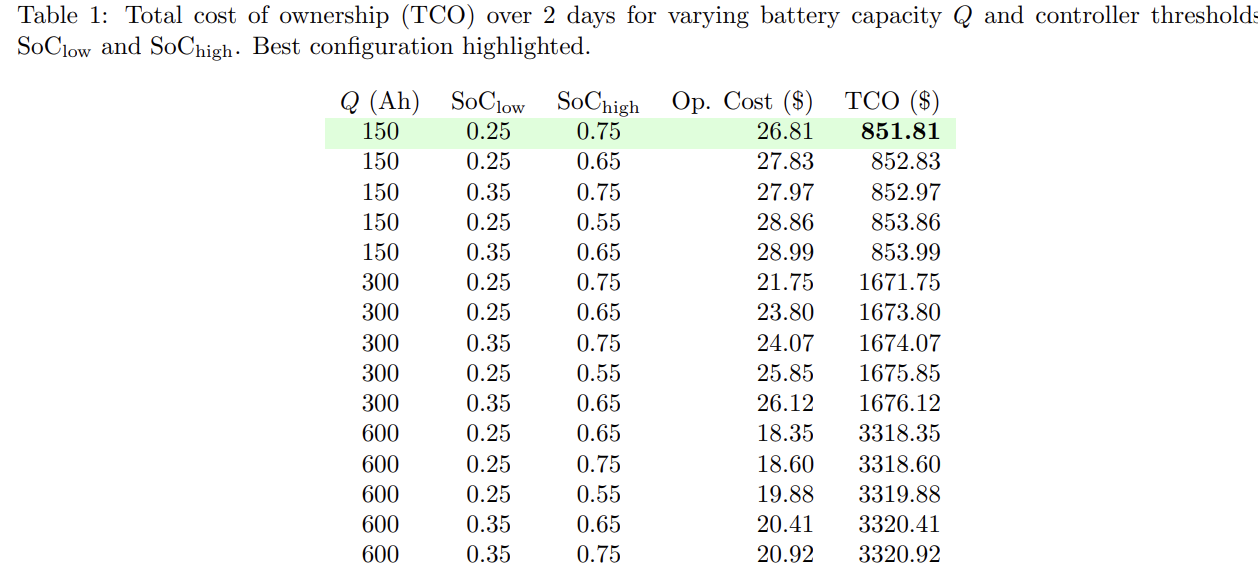
- Ran a full factorial design-space sweep over battery capacity and controller thresholds to jointly optimise total cost of ownership, correctly identifying and explaining a short-evaluation-horizon bias that favoured smaller batteries, then extrapolating to find the true break-even point favouring larger capacity over a longer service life.
- Sized a fully-islanded (off-grid) PV-and-battery system from first principles against worst-case seasonal generation and multi-day autonomy requirements, then benchmarked the workshop’s simplified cost assumptions against live current-day market data to produce a defensible, literature-grounded long-term cost-of-ownership comparison between off-grid and grid-tied hybrid systems.
- Synthesised findings into a broader techno-economic argument for grid-coordinated distributed energy resources over individual off-grid adoption, properly citing and attributing external industry and market sources throughout.