Signal Processing
Active Filter Design — Frequency-Response Analysis and Hardware-Validated Signal Processing
A pair of active-filter design studies: analogue low-pass, high-pass and band-stop filters derived from first-principles circuit analysis, characterised across three independent domains — analytical, simulated, and hardware-measured — and applied to remove an unknown noise tone from a real corrupted audio recording, closing with an open-ended investigation into the design’s underlying performance ceiling.
MATLAB/Simulink (Bode Plot & Discrete Transfer Fcn blocks, Audio Toolbox, c2d discretisation) · Digilent Analog Discovery 2 / WaveForms (Network Analyzer, Wavegen, oscilloscope, spectrum analyser) · breadboard op-amp circuit prototyping · FFT-based audio spectral analysis
Filter Synthesis & Transfer-Function Derivation
- Derived first- and second-order active low-pass and high-pass filter transfer functions from op-amp circuit topologies via nodal analysis, expressing passband gain and cutoff frequency as independently tunable design parameters.
- Derived the dual high-pass response of a second-order filter by swapping its resistive and capacitive elements, re-deriving the full transfer function from scratch and confirming filter type from the circuit’s low- and high-frequency limiting behaviour rather than by inspection.
- Extracted the design’s quality factor from its characteristic polynomial, correctly identifying a critically-damped, repeated-pole response and connecting a classical circuits result to formal pole-placement theory.
Frequency-Domain Characterisation & Cross-Validation
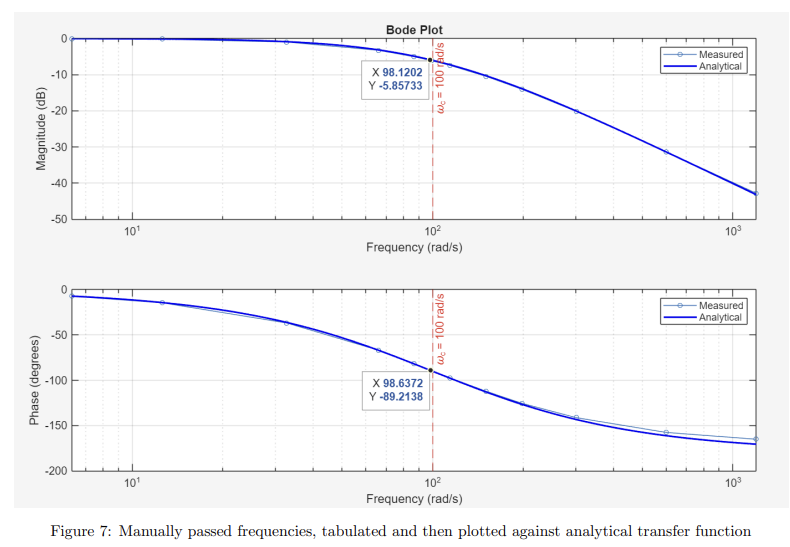
- Characterised each filter’s frequency response three independent ways — closed-form derivation, Simulink’s Bode Plot tooling, and a manually swept hardware measurement — confirming close agreement across all three and validating the design from theory through to a physical breadboard build.
- Explained subtler Bode-plot features (asymptotic slopes, corner-frequency magnitude offsets, phase behaviour at repeated poles and zeros) directly from pole-zero structure rather than treating them as simulation artefacts.
- Diagnosed the modest gap between hardware measurement and theory by systematically ranking real-world contributors — component manufacturing tolerance, op-amp bandwidth limitations, breadboard parasitics, and instrument noise floor — by expected significance.
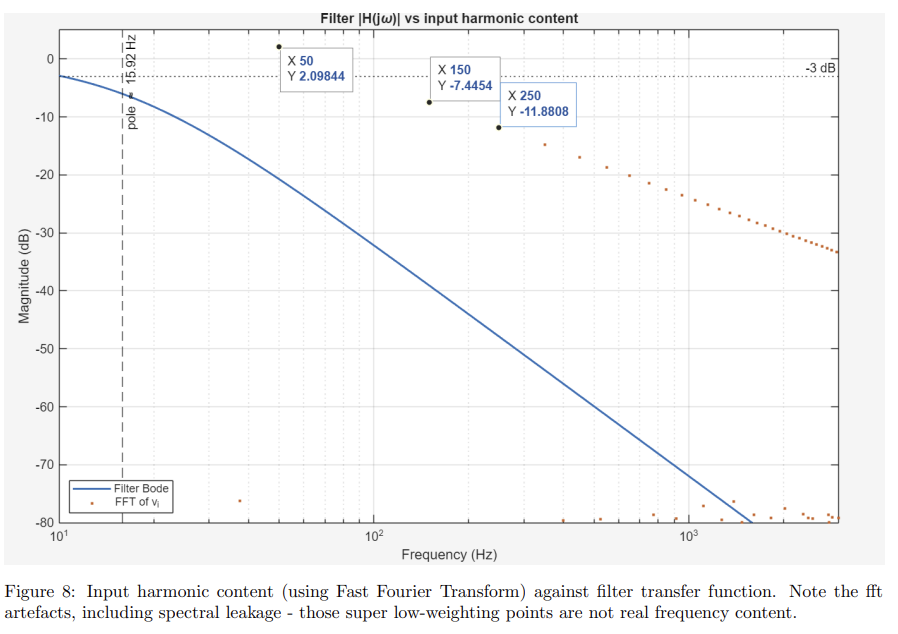
- Applied Fourier/LTI superposition reasoning to predict and verify the filtered output for a non-sinusoidal square-wave input, correctly reconciling the measured response against a naive prediction by accounting for the waveform’s harmonic content.
Band-Stop Filter Design & Digital Signal Processing
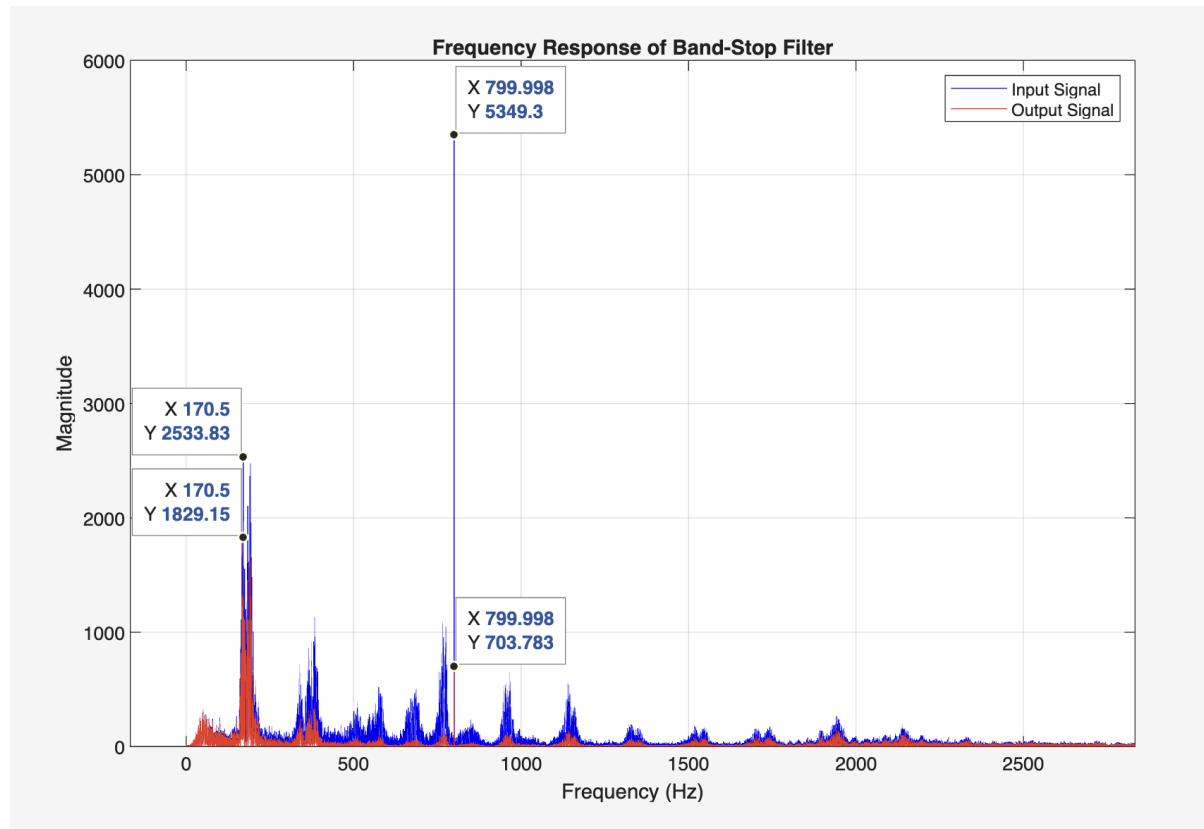
- Identified an unknown noise tone corrupting a recorded audio signal via FFT-based spectral analysis, then used the measured frequency — rather than an assumed one — to directly drive a hardware filter design.
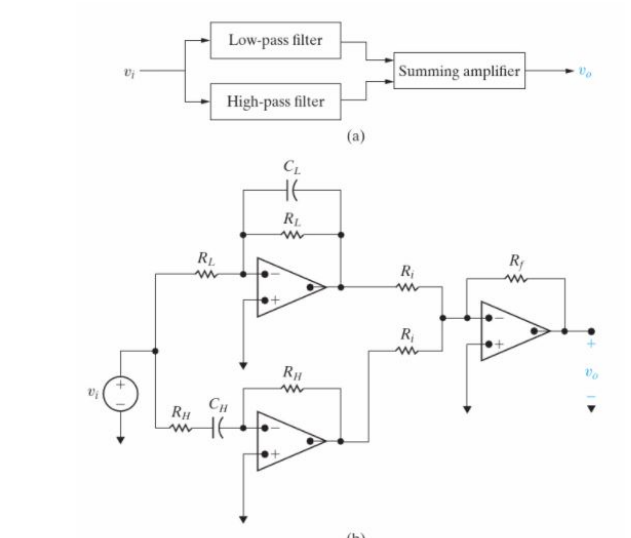
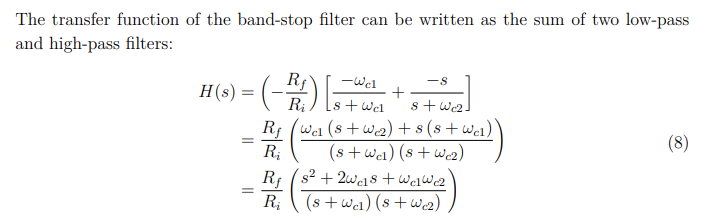
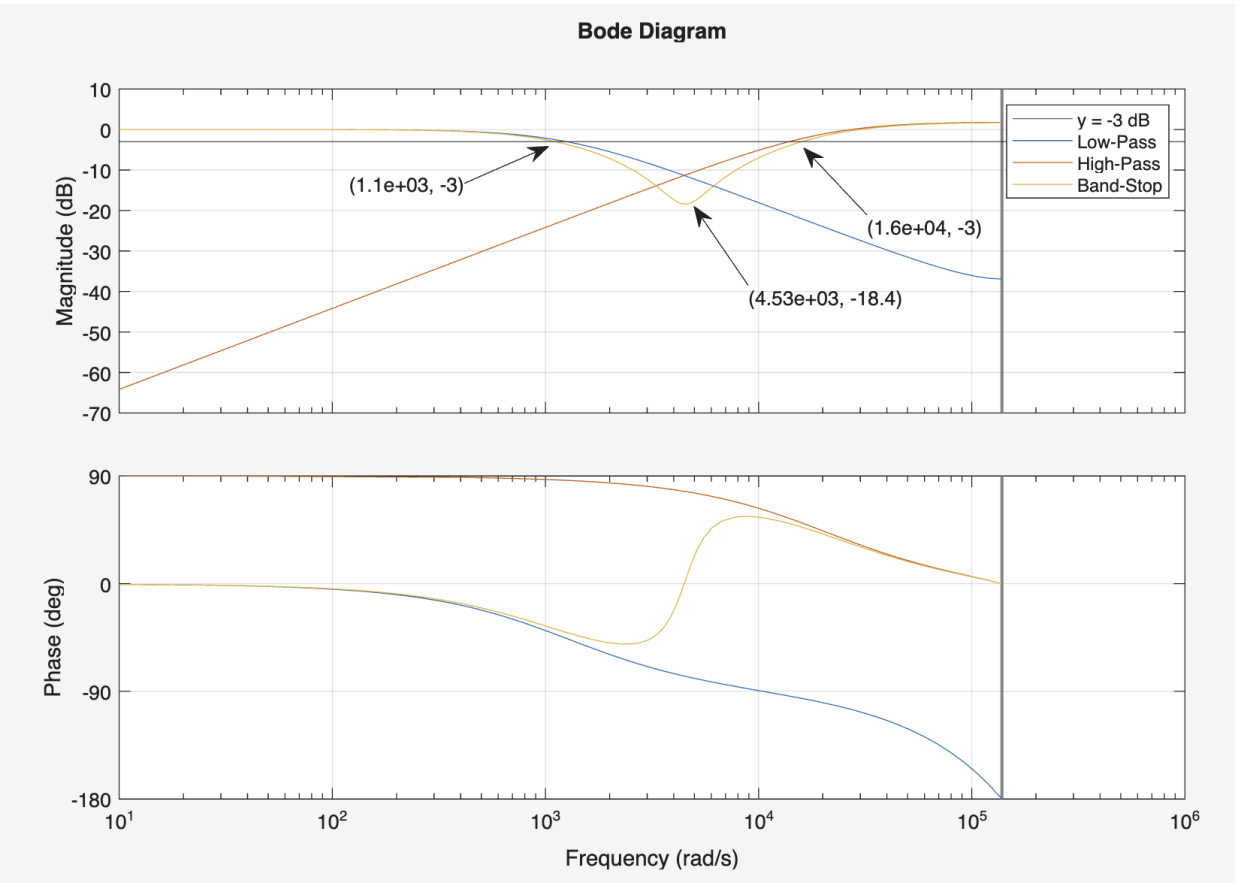
- Synthesised a parallel low-pass/high-pass/summing-amplifier band-stop filter targeting the measured noise frequency, balancing the centre-frequency design constraint against the need to preserve nearby voice content, and sized all passive components against real, kit-available values.
- Discretised the continuous filter design to run in real time against a full audio stream in Simulink, correctly handling the mismatch between continuous-time design and discrete-time execution.
- Cross-validated the resulting digital filter across simulated frequency response, spectral (FFT) comparison of filtered versus unfiltered audio, and physical hardware measurement — and derived an original insight into why the design’s centre frequency proved more robust to component tolerance than its bandwidth.
Root-Cause Diagnosis & Design Trade-offs
- Diagnosed the filter’s incomplete noise rejection as an architectural limitation rather than a build defect: because each parallel branch has a fixed roll-off, notch depth and stopband width are inherently coupled, and no amount of component tuning alone could deepen the notch without encroaching on the voice band.
- Identified a subtler underlying mechanism — that rejection actually arises from phase cancellation between the two branches rather than pure amplitude subtraction — explaining why hardware measurements underperformed simulation by more than component tolerance alone would predict.
- Proposed and critically compared two alternative redesigns against the diagnosed root causes: a true notch-filter topology that decouples depth from bandwidth at the cost of added complexity, versus cascading repeated filter stages that trades duplicated components for compounding but imperfect attenuation — selecting between them based on the specific nature of the measured disturbance.